
How to Pick the Right Graphics Card
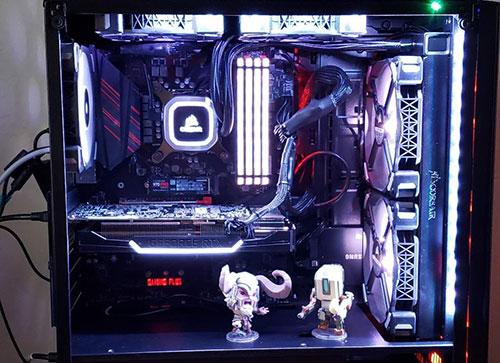
Do you really need the best graphics card on the market?
Will you be fine running the GTX 1070, or do you need something more powerful like the RTX 2080 Ti?
If money is no issue, go with the best graphics card possible. But if you have the best graphics card, you’ll also need the best CPU so that you can reduce the chance of a bottleneck occurring.
When you learn how to pick the right graphics card, you’ll realize one thing: it’s budget dependent.
You may even decide that the RTX 2080 Ti is the right choice for you, but then you’ll find 6-7 manufacturers offering the same card with subtle differences in:
- Clockspeed
- Warranty
- Price
- Overclocking options
If you’re scratching your head wondering which is the best to do, you’re not alone – it’s a lot to absorb.
A few of the things you’ll want to consider are:
- Size. You may be running with a large ATX case, so size won’t matter. But size does matter when a larger graphics card will take up two adjacent PCIe connections. This becomes an issue with smaller, micro-ATX cases.
- Connections. What connections do you need? Older monitors will require a DVI-D connection, but you may need multiple DisplayPort options to accommodate support for multiple monitors. HDMI and DisplayPorts are pretty much standard in all newer graphics cards.
- PSU. Can your current PSU support the required PSU by the graphics card? Since a graphics card is known to hog energy, you may need to upgrade. You’ll also want to consider your connectors. You may need two 8-pin connectors, but your PSU doesn’t have two, so you’ll need to upgrade.
Keep in mind that at the high-end, you may have 5% – 10% differences in cards for a 20% higher price. You need to justify these costs. If you play MMORPGs, you may not need to spend more on a card that is faster because you won’t be able to utilize the excess power.
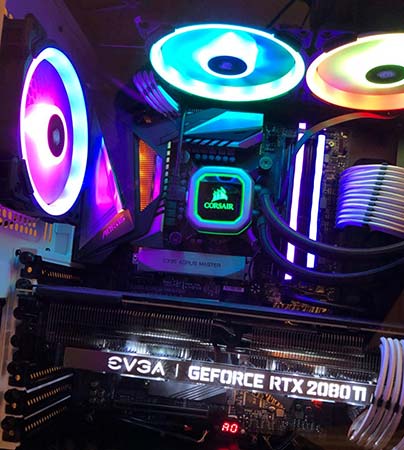
A few things to keep in mind:
- Clockspeed. The clockspeed may not mean much, or it may. Overclocking is especially important because it will produce more speed and require more energy. Some manufacturers, especially MSI, allow for impressive overclocking speeds that keep the card stable and allow you to reach the same performance as those cards that offer the 10% increase we discussed a paragraph ago.
- Cores. Cores matter when all things are created equal, but if there is real-time ray tracing or games that don’t support multiple cores, they may not matter much.
- Noise. A lot of newer cards will keep noise to 0 dB when they’re at lower loads, making them very quiet. But when they run, the noise production may be very high.
There’s also warranty and support concerns. Cards, when they’re defective, will often go bad within the first few months, meaning a year warranty will suffice. But there’s always the benefit of a longer warranty so that you can return the card if an issue happens a year or two into usage.
Support is equally as important because a lot of manufacturers have support that never responds. They’re horrible at responding (when you call no one ever picks up the phone), and even getting an email response is near-impossible.
I also recommend checking out benchmarks online.
Benchmarks will help you compare different cards to see how they perform for your favorite games. Oftentimes, you’ll find that the manufacturer difference for some cards is 10% better for around the same price (when you’re choosing the same card model, but from one of the various manufacturers available).
How to Get Over a Plateau: Strength and Weight Loss Unleashed
Weight training requires dedication and commitment. If you follow a good routine, you’ll lose weight, and gain strength or muscle mass– whichever your goal may be. Everything may be going great for the first month or two until you reach the dreaded plateau.
Everyone reaches plateaus, and a lot of people will quit because they no longer see results.
 This isn’t a new problem, and you can overcome these plateaus to lose more weight or gain more strength and muscle. All it takes is a tweak to your current exercise and diet plan to really see results.
What is a Plateau?
What is a plateau? A plateau is defined as a stall in your progress. You may have been losing weight and gaining muscle for months, but something has changed. You’re no longer reaching your goals or growing stronger. You’re simply stuck without seeing any further results.
Plateaus usually become a problem when you’re:
- Continuing the same exercise routine.
- Continuing the same diet.
Essentially, a plateau can only be a plateau if you’re still following the same routine. This means that your diet that has worked for so long is no longer working, and the same can be said for your workout routine.
Determining if a Plateau is Reached
Before you go into full panic mode, you want to make sure that you’ve actually reached a plateau. This requires a little diligence on your part because you want to analyze everything you’re doing and write it down for a few days, or even a week.
This means that you’ll:
- Track all of your meals. I use myfitnesspal to track all of my meals and have an appropriate macronutrient breakdown, including calories, carbohydrate intake, protein intake and fat intake. If you’re still on track and your progress remains stagnant for the next week or so, you’ve reached a plateau.
- Workouts also need to be tracked. You need an accurate measurement of your workouts. Are you going to the gym as often? Are you following the same set and repetition structure? Monitor all of these metrics because skipping a set or missing a day or two at the gym can hinder your progress greatly.
- What are you doing outside of the gym? If you’re not getting enough sleep, you’ll notice your performance suffers in the gym. Your body simply won’t have enough time to rebuild muscle.
- Is your equipment up to the task? If you are doing cardio on a rowing machine and the resistance isn’t pushing you hard enough then you need to upgrade, these days it’s easy to find the best rowing machine for your budget so you can avoid this issue.
All of these factors can result in a plateau.
Progression Slowed and Not Stalled
Sometimes, people naturally assume that they’ll continue on a linear path with their routine. What does this mean? If you lost 10 pounds during your first and second weeks, you’ll eventually slow down to the point where you only lose maybe 5 pounds a week, or even 1 pound a week – it’s natural.
The same goes for strength training. In the beginning, you may be able to add more and more weight before you eventually hit a wall.
A great example of this can be seen with Olympic weightlifters. An athlete may train daily before they hit a natural genetic limit.
An athlete that bench presses 500 pounds is certainly attempting to reach higher limits. It may take this person a year to be able to lift 510 pounds, even though he increased from 100 pounds to 200 pounds the previous year. There comes a point where progress slows naturally, and progress may actually halt altogether as a person ages.
Change Your Routine
You’ve determined that you’ve reached a workout plateau, and one of the biggest issues is that people like to stay within their own routine. If the routine worked in the past, people have issues with changing what used to work. But your body has a way of adapting to continual stress and routine, meaning that you need to switch things up every once in a while to see results. A workout log book can help prevent this from happening.
Dietary Plateaus
No matter how little you eat, you’ll never be able to hit 0 pounds. Your body will naturally hold onto weight for energy. In fact, eating too little can cause your body to store fat and your metabolism to slow as a sort of defense mechanism.
If you’re following a proper diet, where you expect to lose 1 to 2 pounds per week, you may need to simply change up your routine.
This means:
- Tracking your caloric intake.
- Monitoring body fat.
- Changing your macronutrient breakdown.
Another major issue, especially when trying to lose body fat, is that people tend to look at the scale, but not their body fat measurements. I know many people that have lost a massive amount of body fat, but stayed relatively the same weight. Muscle growth occurs which may not show on a scale, but it will when measuring your body fat.
If you’re not losing body fat or weight, try changing your routine in the gym and take a good hard look at your diet.
Muscle and Strength Plateaus
Every person that has ever entered a gym has reached a plateau. What happens is that the body learns to adapt to the stress and time-under-tension. If you’ve reached this strength plateau, you’ll want to change your routine. This can be done in several ways:
- Add more weight, and reduce reps.
- Reduce weight, and add more reps.
- Change your exercises.
Your body adapts, so you want to change your periodization’s, or “cycles” as people say. Try using resistance bands for the next to set. Do pyramids where you incrementally increase and decrease the weight. Engage in HIIT, or simply change the exercises you’re doing to overcome your plateau and finally achieve the results you want.
Cardiovascular Plateaus
Plateaus don’t only apply to weight lifters. Long distance runners, cyclists and other such sports can also experience plateaus. They also need to mix up their workouts to keep the body guessing.
For instance, a long distance runner might do some hill walking or swap the treadmill out for a treadcilmber once or twice a week (if you unsure of what a treaclimber is see these Bowflex Treadclimber Reviews). This will help engage different muscles and keep your body guessing and developing.
Even increasing the number of times you stretch can help you overcome a plateau. Stretching can also make you stronger and less likely to pick up injuries.